
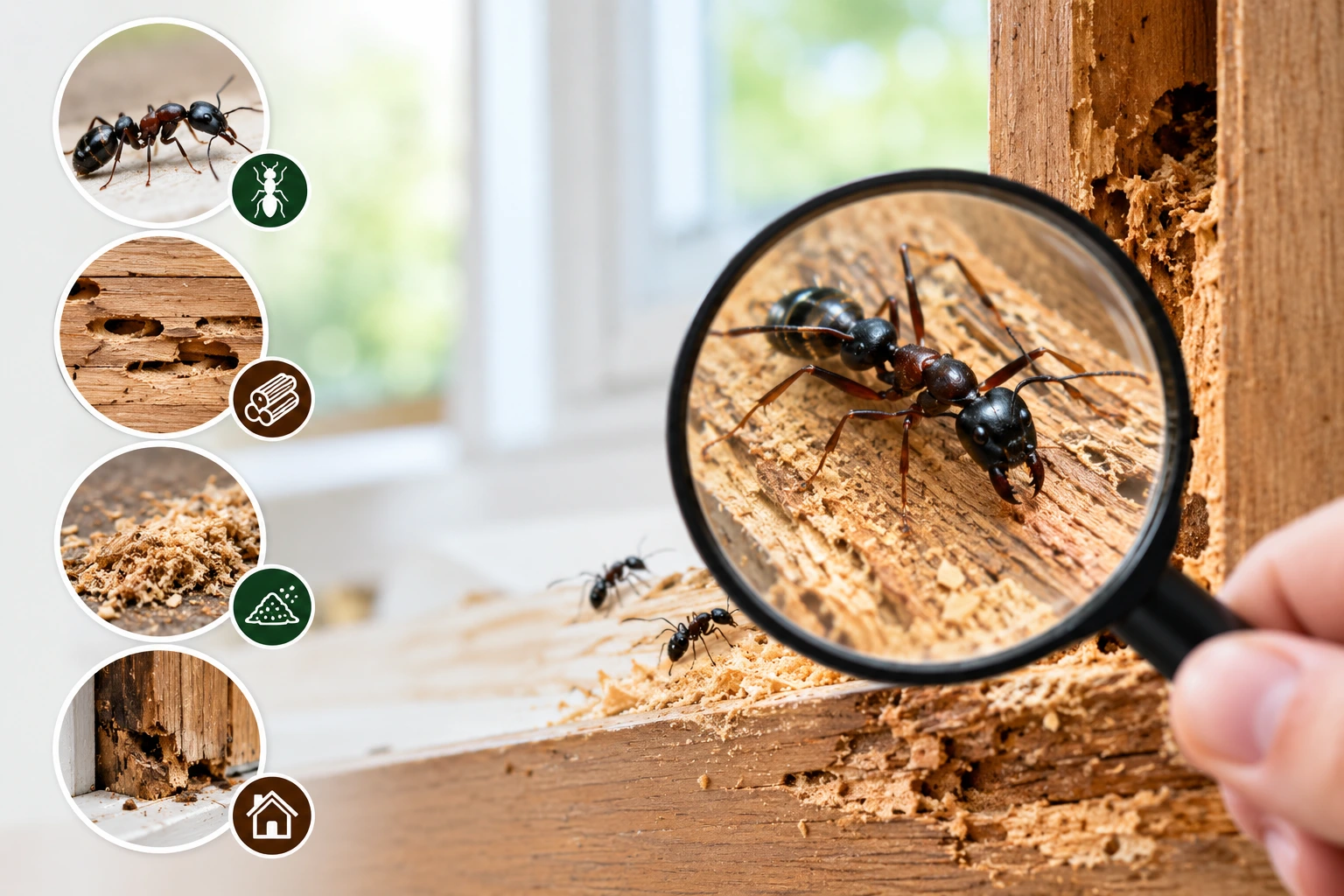
If you have noticed ants around your home, you may be wondering: What are the first signs of carpenter ants? Recognizing the early warning signs can help you investigate the problem before the infestation becomes more established. Carpenter ants can be found indoors and outdoors, particularly around areas where moisture has affected wooden structures.
Table of Contents
ToggleWhat are Carpenter Ants and Wood Damage?
Carpenter ants excavate wood to create nesting galleries. They prefer wood that has been weakened by moisture, decay, or previous damage.
- Areas around leaking plumbing, roof leaks, poorly ventilated spaces, windows, doors, decks, and tree branches can provide favorable conditions.
- Unlike termites, carpenter ants do not consume the wood. They remove material while creating tunnels and nesting chambers.
- If an infestation remains active for a long time, the affected wood can become increasingly compromised.
- The extent of damage depends on the size and duration of the infestation and the condition of the wood.
Sawdust-Like Material Near Wood
One useful clue is the presence of material that resembles sawdust near wooden surfaces. This material is often called frass and can contain wood particles and other debris removed from carpenter ant galleries.
- Wall openings
- Window frames
- Door frames
- Wooden beams
- Baseboards
- Attics
- Crawl spaces
- Deck structures
How is Carpenter Ant Activity at Night?
Carpenter ants are more active at night. If you suspect an infestation, carefully inspect areas where you have seen ants after dark.
- Use a flashlight and look along baseboards, window frames, plumbing penetrations, wall openings, and other areas where ants may travel.
- Avoid disturbing electrical wiring or entering unsafe areas while investigating.
- If ants repeatedly disappear into a wall, ceiling, or wooden structure, professional inspection may be appropriate.
How Can I Find a Carpenter Ant Nest?
If you are asking, How can I find a carpenter ant nest? Start by observing where the ants are coming from and where they are going.
Follow visible trails when possible. Carpenter ants may travel considerable distances between their nest and food or water sources, so the location where you see ants may not be the location of the nest.
- Moisture damage
- Rotting wood
- Leaking pipes
- Roof or gutter leaks
- Tree branches touching the building
- Cracks around windows and doors
- Wall voids
- Attics and crawl spaces
- Wooden decks and other exterior structures
Carpenter ants can establish a primary nest outdoors and satellite nests inside or near a building. This means eliminating only the ants that are visible may not resolve the underlying problem.
What Kills Carpenter Ants Instantly?
Many of you ask, What kills carpenter ants instantly? Some products can kill individual ants quickly when they come into direct contact with them.
- However, killing visible ants does not necessarily eliminate the colony.
- The larger concern is locating and addressing the nest.
- If only foraging ants are killed, additional ants may continue to emerge from an established colony.
- Professional pest control treatments can focus on identifying the infestation and selecting an appropriate treatment strategy.
- Treatment methods depend on the location of the nest, the extent of activity, and the structure of the property.
- You should always follow product labels and safety instructions when using any pest-control product.
Why Killing Visible Ants May Not Be Enough?
Seeing several carpenter ants can be frustrating, but spraying or killing individual ants may provide only temporary relief.
- Foraging ants leave the nest to search for food and water. If the colony remains active inside a wall, tree, structural void, or another location, more ants can continue to appear.
- This is why identifying the source of activity is an important part of effective carpenter-ant management.
- A professional inspection can help determine whether the infestation is concentrated indoors, outdoors, or in multiple locations.
Which Signs Show Professional Pest Control May Be Needed?
Our pest control may be appropriate when carpenter ants appear repeatedly, especially if they are accompanied by wood debris, structural damage, or evidence of nesting.
- Ants continue appearing after basic cleaning
- You find ants emerging from walls or ceilings
- Sawdust-like material repeatedly accumulates
- Wooden areas show moisture damage
- Winged ants appear indoors
- Ant activity returns after treatment
- You cannot locate the source of the infestation
How to Prevent Carpenter Ant Infestations?
Prevention starts with reducing conditions that attract or support carpenter ants.
- Keep gutters and downspouts functioning properly so water moves away from the building.
- Repair leaks promptly and address areas of standing moisture.
- Trim branches that touch or closely approach the structure.
- Store firewood away from the house and keep it elevated where practical.
- Seal cracks and gaps around windows, doors, utility penetrations, and other possible entry points.
- Regularly inspect wooden structures for signs of moisture, decay, or insect activity.
These measures do not guarantee that carpenter ants will never appear, but they can reduce opportunities for nesting and entry.
Frequently Asked Questions
Are carpenter ants dangerous to people?
Carpenter ants generally do not pose a serious threat to people. However, an established infestation can damage wood by excavating nesting galleries, particularly in areas affected by moisture or decay.
Do carpenter ants always mean there is a nest inside the house?
Carpenter ants may enter a home while traveling between an outdoor nest and food or water sources. Repeated indoor activity can indicate a nearby nest or satellite colony, so an inspection can help determine the source.
Where are carpenter ants commonly found?
Carpenter ants are often found near damp or deteriorating wood, including areas around leaking pipes, roof leaks, windows, doors, crawl spaces, attics, decks, and trees located close to a building.
Can carpenter ants come back after treatment?
Carpenter ants can return if the nest is not fully addressed or if moisture and other favorable conditions remain. Identifying and correcting conditions that support nesting can help reduce recurring activity.
How can I prevent carpenter ants from entering my home?
Repair moisture problems, maintain gutters and downspouts, replace damaged wood, seal cracks and openings, trim branches away from the structure, and keep firewood away from the building.