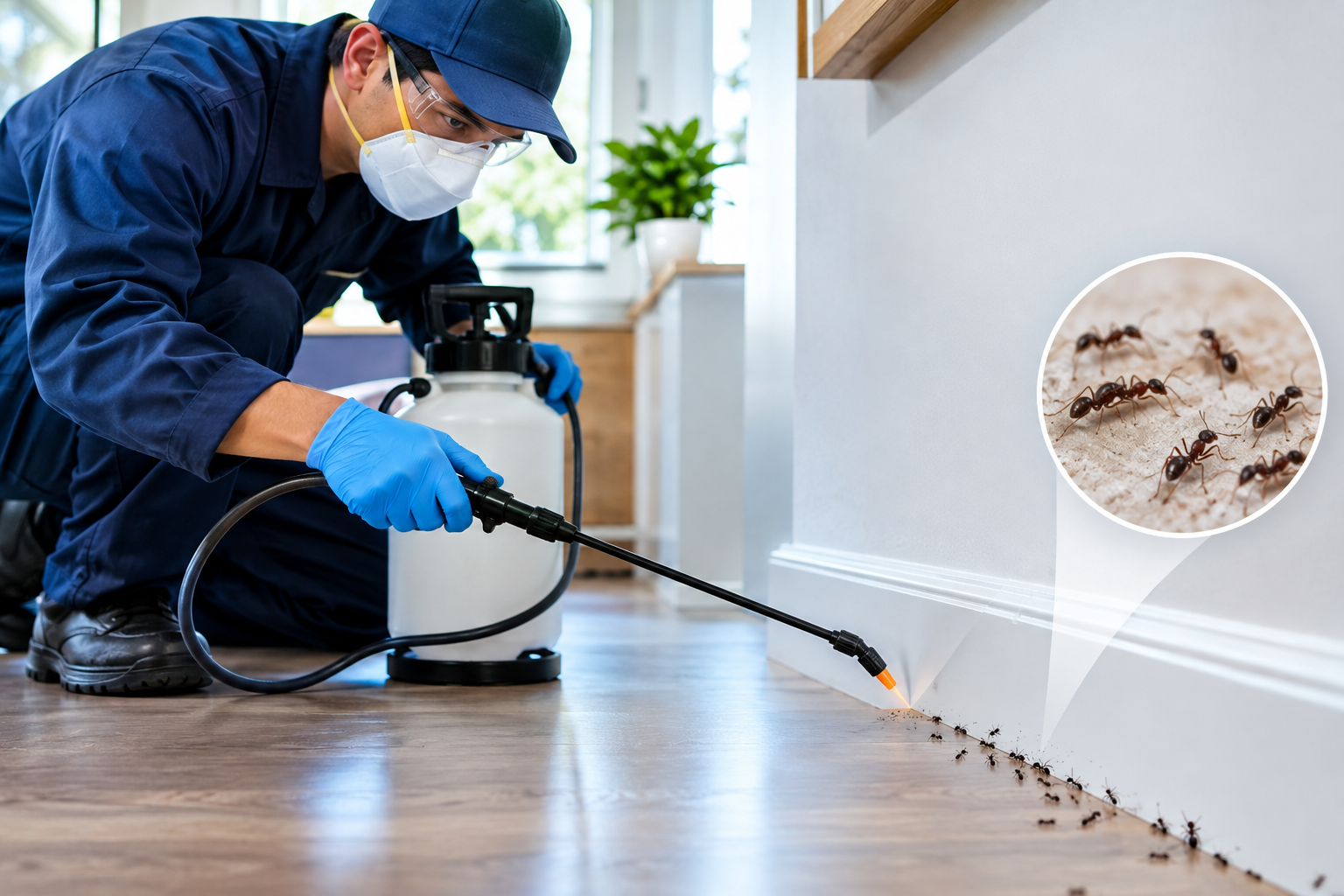
Ants may be small, but a large infestation can quickly become a frustrating household problem. You may notice ants moving along kitchen counters, entering through windows, appearing around sinks, or creating trails across floors. Our professional ant pest control treatment & removal services can help identify where ants are coming from, determine the type of infestation, and develop an appropriate treatment strategy.
Table of Contents
ToggleWhy Do Ants Enter Homes?
Ants usually enter properties when searching for food, water, or shelter. Even small crumbs, spilled drinks, pet food, or moisture around plumbing can attract them.
- Food crumbs on floors or counters
- Open food containers
- Sugary spills
- Pet food left uncovered
- Leaking pipes or faucets
- Moist areas around sinks
- Cracks around doors and windows
- Gaps in walls or foundations
- Outdoor vegetation touching the building
What are the Signs of an Ant Infestation?
The most obvious sign is seeing ants indoors, but there are other clues you should watch for.
- You may notice consistent ant trails along walls, floors, countertops, or windowsills.
- Small piles of soil near outdoor entry points may indicate nesting activity.
- In some situations, you may find ants around plumbing areas, under appliances, or inside cabinets.
- Different ant species may behave differently, so identifying the type of ant can help determine the most suitable treatment approach.
- If ants continue appearing despite regular cleaning, the colony may be located inside a wall, beneath flooring, around the foundation, or somewhere outside the property.
Does Pest Control Actually Get Rid of Ants?
A common question you ask is: Does pest control actually get rid of ants? Our professional pest control can be highly effective when the treatment addresses the infestation at its source.
Moreover, killing visible ants may provide temporary relief but does not necessarily eliminate the colony. A successful treatment strategy includes identifying where ants are nesting, determining how they are entering the property, and reducing the conditions that allow them to thrive.
Depending on the situation, pest professionals may use targeted treatments, baiting methods, perimeter applications, or other appropriate techniques.
The exact approach depends on the ant species, infestation size, nesting location, property conditions, and whether the colony is indoors or outdoors.
What Are Some Ant Control Methods?
Many of you ask, What are some ant control methods? Several approaches can be used depending on the type and severity of the infestation.
Ant Baiting
Baiting can be useful because worker ants may carry the bait back toward the colony. This approach focuses on reaching ants beyond those that are immediately visible.
Targeted Treatment
Specific areas where ants are entering or nesting may receive targeted treatment. This can help limit unnecessary application to unaffected areas.
Perimeter Treatment
In some situations, treating suitable areas around the exterior of a property can help reduce ant activity and limit potential entry points.
Entry-Point Sealing
Cracks and gaps around windows, doors, pipes, and foundations can provide convenient access for ants. Sealing these openings can support long-term prevention.
Sanitation and Moisture Control
Removing food residue and fixing moisture problems can make the property less attractive to ants.
Why DIY Ant Control May Not Be Enough?
Store-bought sprays can kill ants that are directly exposed, but they may not solve the underlying infestation. If the colony remains active, new ants can continue appearing.
Another problem is applying products without knowing the ant species or nesting location. Some infestations require a targeted approach rather than repeated spraying.
You should also carefully follow product labels when using any pest-control product. Incorrect application can create unnecessary risks for people, pets, and indoor surfaces.
Our ant pest control treatment & removal services provide a more structured approach by first assessing the infestation and then selecting suitable treatment methods.
What is the Professional Ant Inspection and Treatment Process?
A thorough pest-control process begins with an inspection. The technician looks for active ant trails, nesting areas, entry points, moisture sources, and conditions that may be attracting the insects.
- The property is checked for visible activity and potential nesting locations.
- Identifying the ant species can help determine its behavior and preferred nesting environment.
- A suitable treatment plan is selected based on the infestation and property conditions.
- Appropriate methods are applied to active areas, entry points, or nesting locations.
- Potential entry points and attractants are addressed to reduce future activity.
- Depending on the severity of the infestation, follow-up inspections or additional treatment may be recommended.
How to Prevent Ants From Returning?
Treatment is only one part of long-term ant management. You can take several steps to make your property less attractive to ants.
- Keep countertops, floors, and dining areas free from food crumbs. Store sugar, cereals, snacks, and other food products in sealed containers.
- Pet food should not remain exposed for extended periods. Garbage containers should remain closed and be emptied regularly.
- Check for leaks beneath sinks and around appliances. Addressing excess moisture can eliminate another resource that attracts ants.
- Outside the home, remove accumulated leaves and organic debris near walls and foundations.
- Keep plants and branches trimmed away from the building where practical.
Frequently Asked Questions
How do I know if I have an ant infestation?
Repeated ant trails, ants appearing in several rooms, nests near the property, or continuous activity despite cleaning can indicate an infestation. Finding ants around food, sinks, windows, and wall openings may also be a warning sign.
How long does professional ant treatment take to work?
Results depend on the ant species, colony size, nesting location, and treatment method. Some activity may decrease quickly, while eliminating an established colony can require additional time and follow-up treatment.
Why do ants keep coming back after I spray them?
Spraying visible ants may only remove the workers you see. If the nest or colony remains active, more ants can continue entering the property.
Are ant infestations difficult to eliminate?
The difficulty depends on the species, colony location, infestation size, and conditions of the property. Indoor nests, multiple entry points, and persistent moisture can make treatment more challenging.
How can I prevent ants after professional treatment?
Keep food sealed, clean spills promptly, remove crumbs, manage household moisture, keep garbage covered, clean gutters and outdoor debris, and seal cracks or gaps around potential entry points.